
Who Gets to Be Called a Chef?
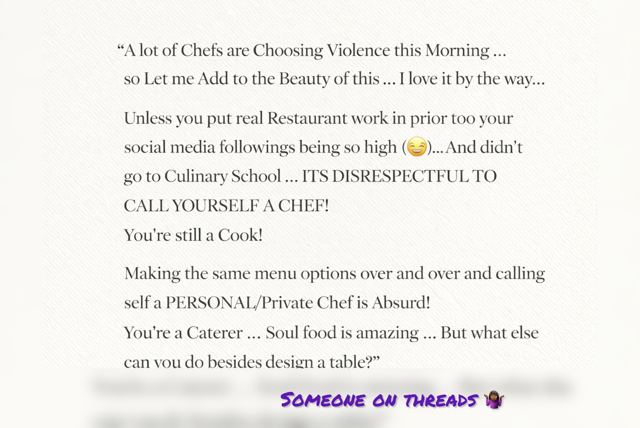
Someone on threads, opinion
I am a personal chef located in Westchester County, NY. Serving the Tri state area.
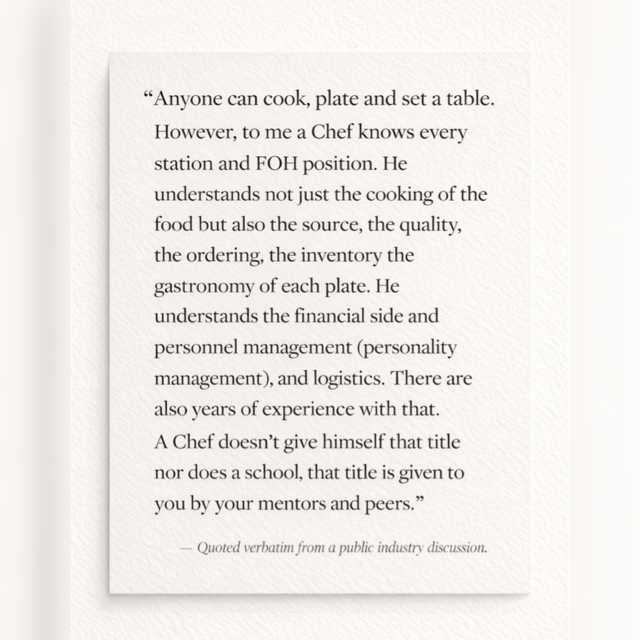
Somebody elses opinion
Chef Jaime is a personal Chef & Caterer in New York, New Jersey & Connecticut.
Every few months, this conversation resurfaces.
Who “earns” the title.
Who doesn’t.
Who belongs.
Who should stay in their lane.
Lately, I’ve seen a familiar argument make the rounds again: that unless you came up through traditional restaurant kitchens, worked every station, logged the hours, went to culinary school, and earned the approval of mentors and peers, you shouldn’t call yourself a chef. At best, you’re a cook. Maybe a caterer. Definitely not a chef.
I understand where that perspective comes from.
I also know its limits — because I took the route being defended.
I worked in professional kitchens. I learned systems, hierarchy, discipline, and standards. I understand sourcing, inventory, ordering, food cost, staffing, FOH and BOH flow, logistics, execution, and pressure. I understand what it means to be responsible not just for food, but for people, timing, money, and outcomes.
And here’s the part that rarely gets said out loud:
Even when you take the “right” path, the title is not always given.
Not equally.
Not consistently.
Not to everyone.
Depending on who you are — how you look, where you come from, how loudly or quietly you take up space — recognition can still be withheld. You can do the work, carry the weight, and still be told you haven’t done enough. Or that your work somehow stops “counting” once it leaves the four walls of a restaurant kitchen.
So what happens then?
You stop waiting.
You stop asking permission from systems that were never designed to affirm everyone the same way. You stop chasing validation that moves the goalposts every time you get close.
And instead, you build.
You refine your craft.
You take responsibility end-to-end — from concept to sourcing to execution to service.
You lead teams.
You manage logistics.
You design experiences.
You stand behind your work publicly and professionally.
You carry the wins and the failures.
That isn’t avoiding the craft.
That is the craft.
The idea that a chef must look one specific way, come from one pipeline, or remain inside one model to be legitimate is outdated. The industry has changed. The work has expanded. The skills required today — adaptability, entrepreneurship, leadership, creativity, hospitality, and execution outside controlled environments — are not lesser skills. They are additional ones.
Calling someone “just a cook” or “just a caterer” isn’t about protecting standards. It’s about protecting identity. About preserving a hierarchy that feels familiar — even when it no longer reflects reality.
And let’s be honest: repeating the same menus, running the same stations, inside the same structures for years doesn’t automatically make someone more skilled than a chef designing bespoke experiences, adapting to new kitchens weekly, managing clients, staff, budgets, dietary needs, logistics, and execution without the safety net of a brigade.
Titles don’t come from Instagram.
They don’t come from culinary school alone.
And they don’t only come from restaurant kitchens.
They come from responsibility.
From consistency.
From accountability.
From peers and clients who trust you with their time, money, and expectations — and come back.
Some people are named by institutions.
Others are named by the work itself.
So if you’re waiting for permission, here’s the truth:
Sometimes, it never comes.
And that doesn’t mean you didn’t earn it.
It just means you made your own way — and let your work speak for you.
A Final Reflection
There’s also something else I’ve learned along the way: sometimes the box people try to put you in was never meant to be your home.
I believe we’re each given a path long before we understand it — before titles, before institutions, before permission. And along the journey, there are moments when we’re tested: stay where it’s familiar, or follow the pull toward what feels aligned, even when it doesn’t fit someone else’s definition of success.
If you’re wrong, the box will still be there.
It always is.
But if you’re right — if you follow the road that was made specifically for you — the peace on the other side is something else entirely. A kind of clarity. A quiet joy. A freedom that comes from being who you were meant to be, not who someone else decided you should be.
That kind of peace doesn’t need a title to validate it.